Table of Contents
Introduction
When comparing Maine Coon vs Domestic Long Hair, many cat lovers feel confused at first glance., both cats look the same and are equally fluffy and pretty. However, when looking at the two cats, the differences are more than just looking at fur and cuteness. A Maine Coon represents a well-defined breed shaped by history, selective breeding, and genetic consistency. On the other side, a Domestic Long Hair, is a cross breed of long haired domesticated cats, and have mixed ancestry, which makes their traits less predictable. This difference explains the wide variation that a Domestic Long Hair has in its personality, grooming needs, long term health, and behaviour. Because of the lineage of the Maine Coons, the breed has been controlled and monitored, while the Domestic Long Hairs have diverse lineage that has not been controlled at all. This is the main difference between the two breeds. According to the Cat Fanciers’ Association, pure breeds like Maine Coons follow strict breed standards that ensure consistency in physical traits and temperament.
People have cats for a combination of reasons, and the two main reasons are the level of control that can be exercised over a breeding line and the level of unpredictability that can be expected in a population of cats that survived in a community. The first of these describes cats that have gone through selective breeding, and the second describes cats that have gone through domestication. The first gives predictability and the second gives a more interesting and different personality that is unique. Understanding this contrast allows you to make a better decision based on your lifestyle. Whether you want a predictable companion or a unique feline personality, this guide will give you deep insights that most basic comparisons overlook.
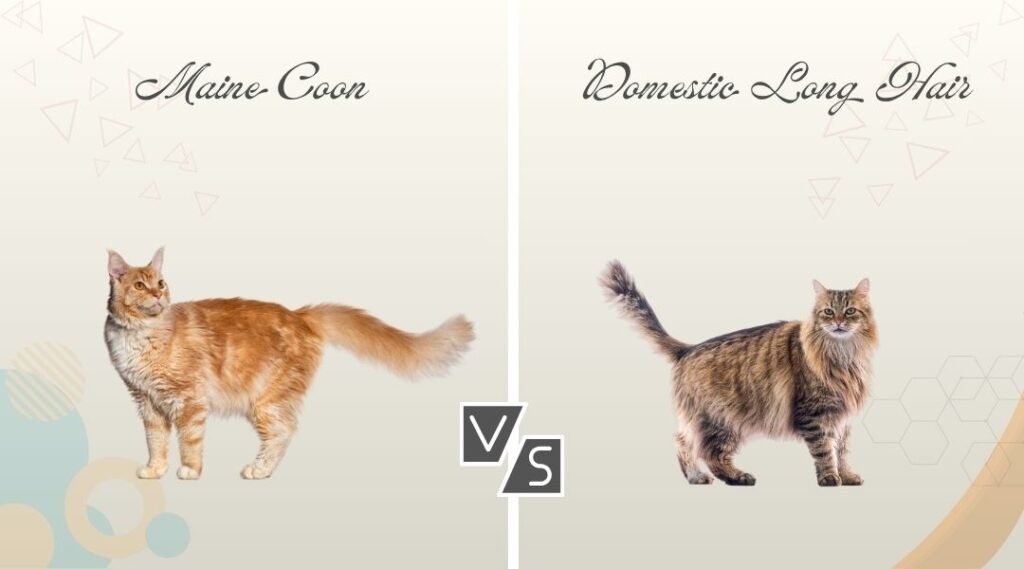
Maine Coon vs Domestic Long Hair Cat Side by Side Difference
Origin and History
Originating in New England, the Maine Coon breed descends from rugged and cold environments and from the value of strength, adaptability, and intelligence. Early settlers integrated the Maine Coon into their households and farms, using them to manage vermin infestations (including mice and small squirrels, which threatened food stores). Over generations, natural selection combined with selective breeding refined their structure, coat, and calm temperament. Some stories suggest connections to longhair cats brought by European sailors, though these remain more rumour than proven fact. Still, their history reflects a powerful blend of domestication and environmental adaptation.
On the other hand, the Domestic Longhaired Cat is the product of many different ancient wildcat species (such as Felis sylvestris), which have been present in the Near East and Middle East for thousands of years. These cats are believed to have coexisted with some of the first domesticated agricultural societies and have since dispersed around the globe, adapting to different environments and climates. Instead of a defined breed, the Domestic Longhaired Cat is the result of random genetic mixing of cat population. It’s not surprising, then, that the variety of their appearance, behaviour, and temperaments is so great.
Physical Appearance (Maine Coon vs Domestic Long Hair)
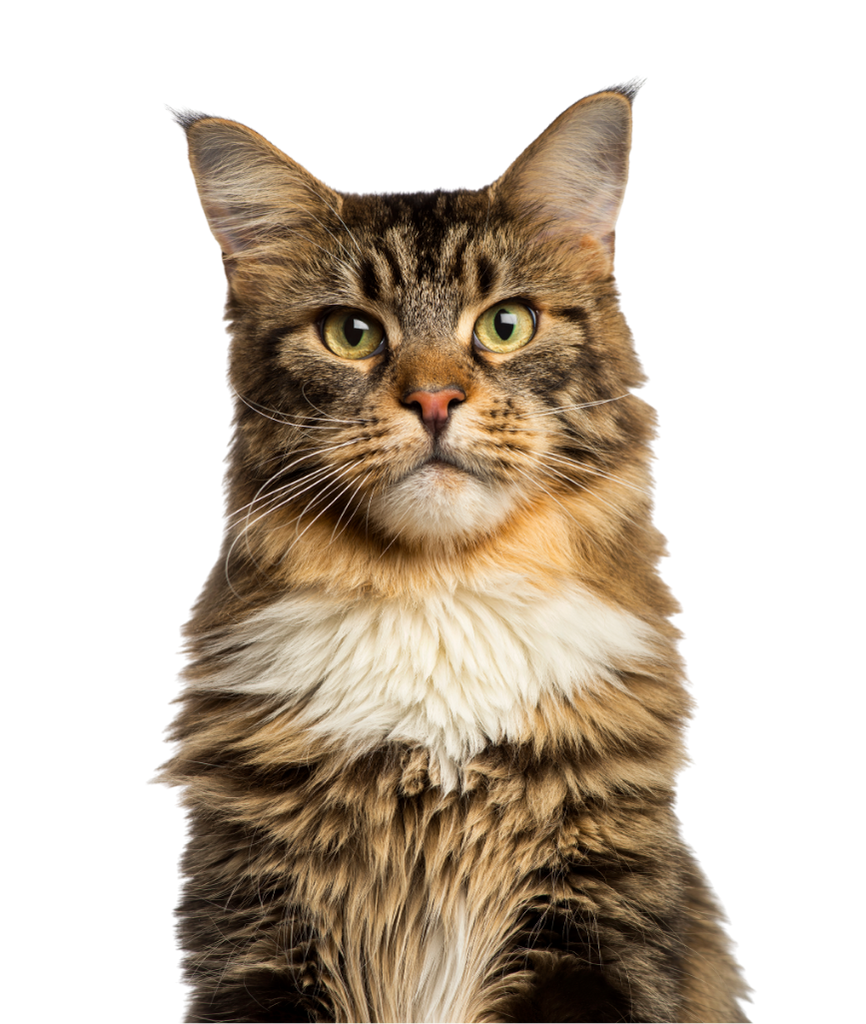
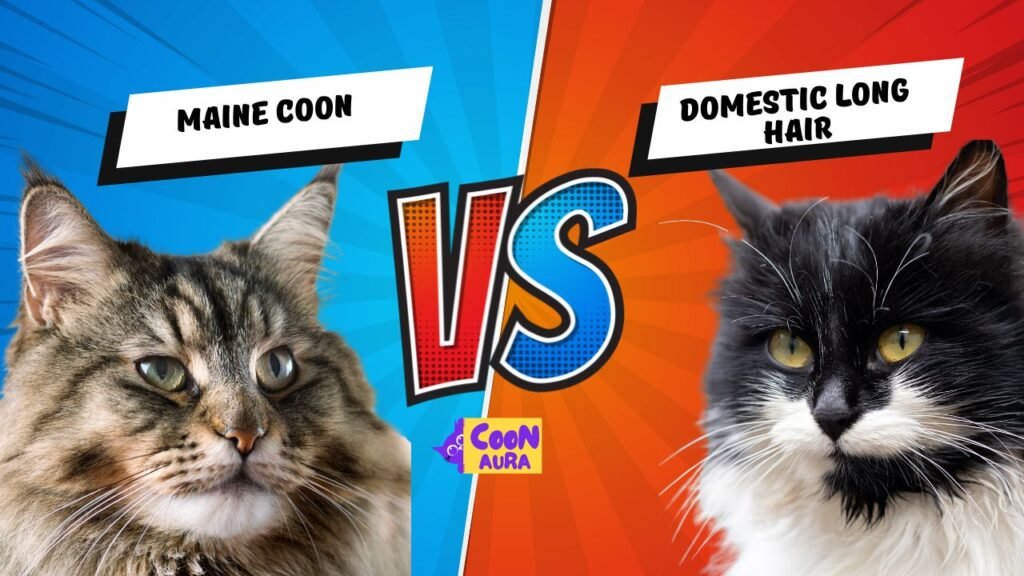
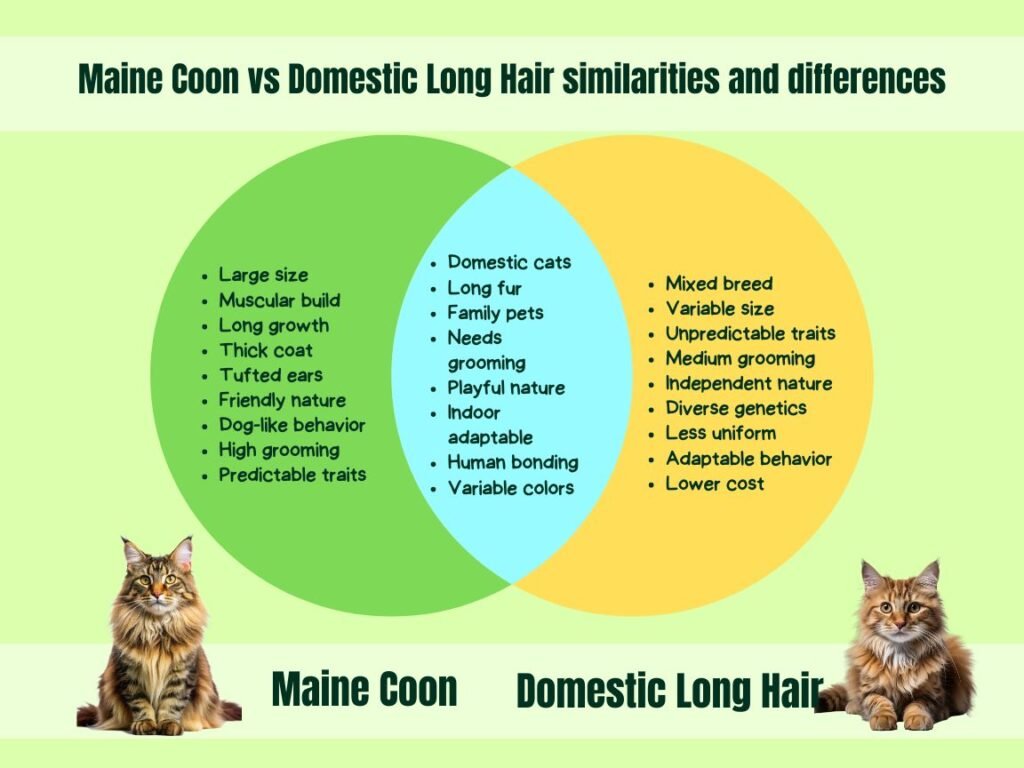
One of the most noticeable differences, yet often misunderstood, when comparing the Maine Coon and the Domestic Long Hair is their physical appearance. The Maine Coon is powerful; it has a muscular body and long, bushy tail. They have distinct tufts on their ears, which make them look a bit wild but also regal. Their coat also has a thick mane, which gives them a strong resemblance to lions, which is something many of their owners appreciate. This is consistent in appearance, due to their controlled breeding, which helps to preserve specific traits in their lineage over generations. Breed standards published by The International Cat Association highlight features like ear tufts, large size, and a bushy tail as defining traits of Maine Coons.
In contrast, a Domestic Long Hair cat shows an amazing amount of variation. This means a wide variety of individual traits and characteristics can be present in them individually. For example, one of the DLH may have a thin body and silky fur while another may be more important and have a heavy coat with a prominent tabby pattern. This variation means with a decline in the presence of controlled breeding. As a result, a DLH can be difficult to distinguish if you look at them closely. Their appearance is a combination of a variety of underlying causes, which may be genetic, environmental, adaptive and sometimes, random which can result in a lack of sufficient confidence.
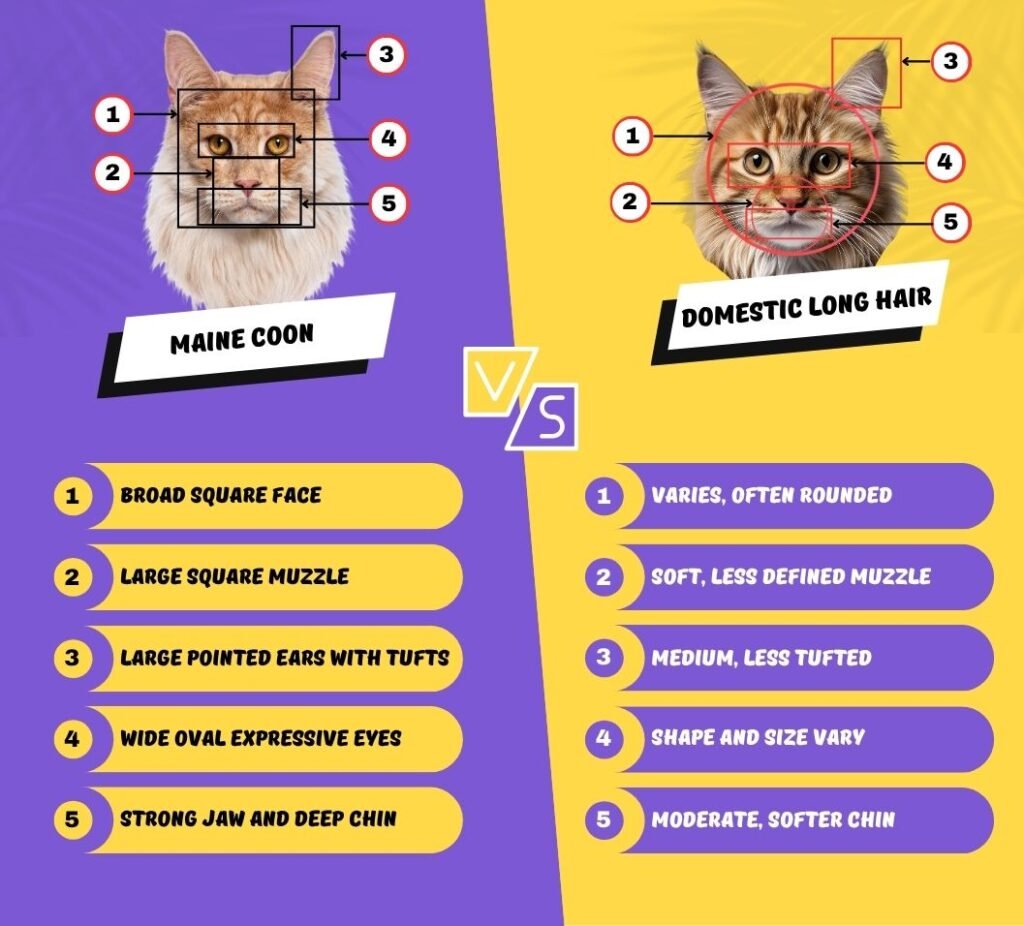
Comparison between Facial Features of Maine Coon and Domestic Long Hair Cat
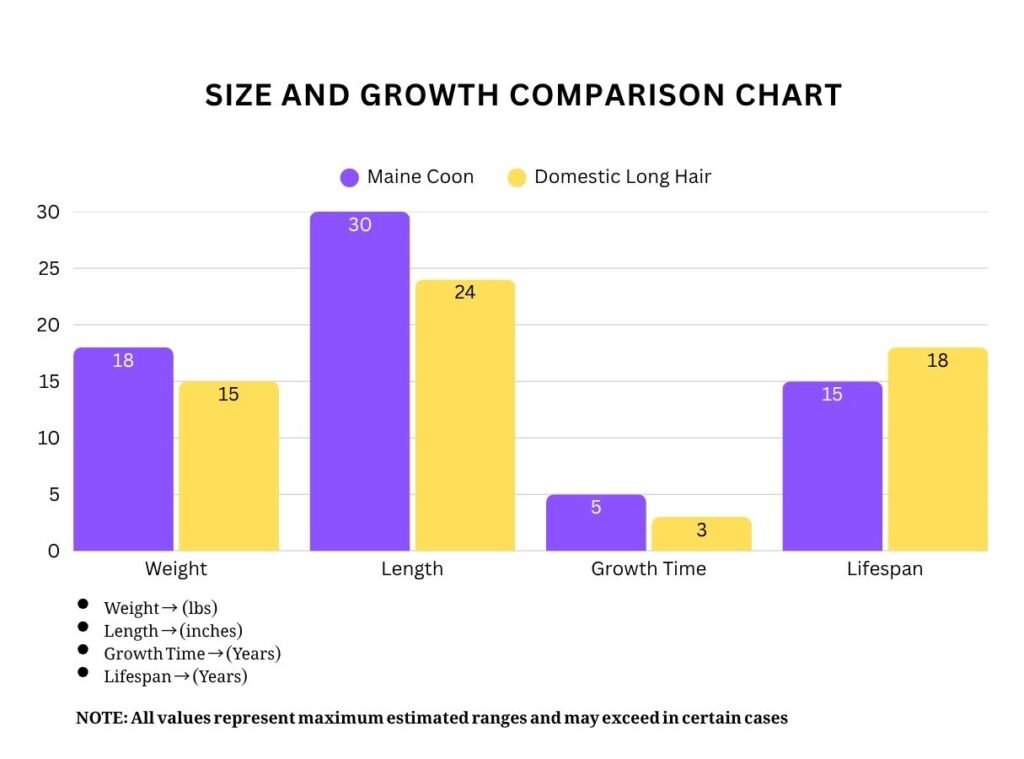
Maine Coon vs Domestic Long Hair Size and Growth Differences
Surprising many new cat owners, size differences between Maine Coons and Domestic Long Hairs involve not just weight but also growth patterns and body structure. Maine Coons tend to grow much slower than Domestic Long Hairs, taking about four to five years to reach their full size. However, this longer growth time leads to a much more developed body structure. Maine Coons are muscular; their body composition is solid, and the overall weight and size is balanced. The presence of Maine Coons is apparent, and is often attributed to the animal carrying itself with a calm, confident demeanour. For a deeper breakdown, you can explore Maine Coon Size and how these cats compare to other large breeds.
The growth of Domestic Long Hairs is more unpredictable and dependent on many external factors like diet, environment, and more importantly, the genetic make-up of the individual cat. While some Domestic Long Hairs may remain smaller, and even lighter, there are instances of individuals growing to weigh more than some pure breeds. The size variation of Domestic Long Hairs is attributed to the mixed genetic carriers of their lineage. Maine Coons set standards for growth – Domestic Long Hairs are more unique, but also less consistent.
Coat type, Fur texture and colours
Especially comparing environments, Maine Coons’ coats serve practical and aesthetic purposes as they are thick, long, and layered for insulation and oily to repel water and skin. They take regular brushing to avoid tangles to keep them shiny. The colour and pattern variety is appealing and consistent across individuals.
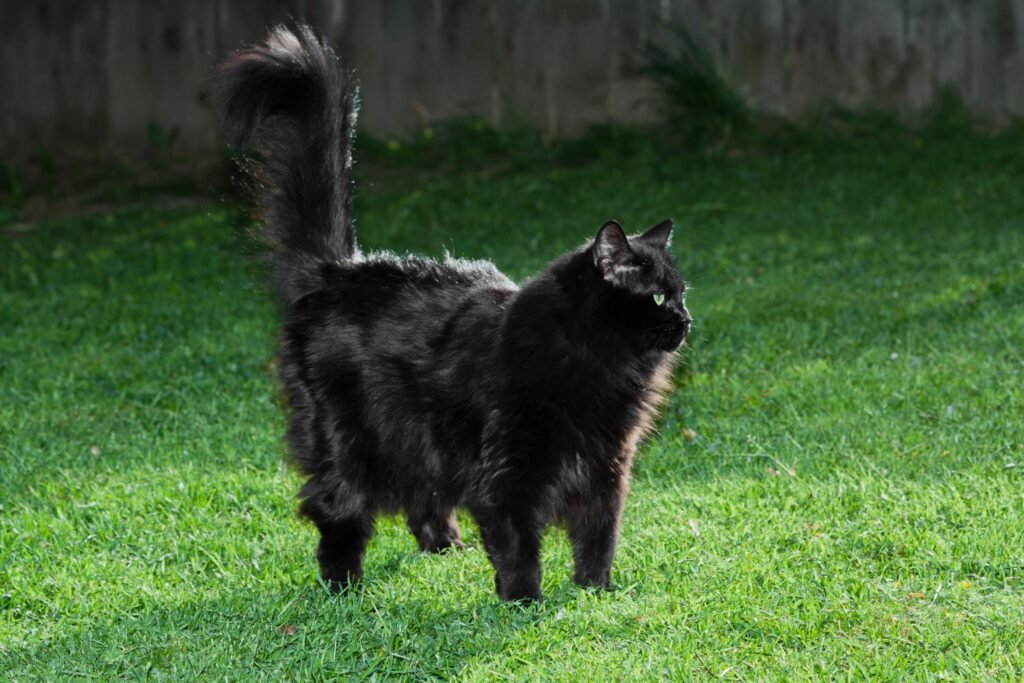
Domestic Longhairs have mutts for mixed ancestry and lack uniformity. Some have fur that is dense and requires lots of grooming while others’ coats are less so. They possess all kinds of colours and patterns that contribute to their genetic pool from solid to complex tabby patterns and designs. They are visually appealing, but grooming will be unpredictable. The coat is like a reflection of their genetic history and their environmental adaptation.
| Feature | Maine Coon | Domestic Long Hair |
|---|---|---|
| Fur Type | Thick and layered | Variable |
| Texture | Dense | Silky to rough |
| Colors | Wide variety | Unlimited patterns |
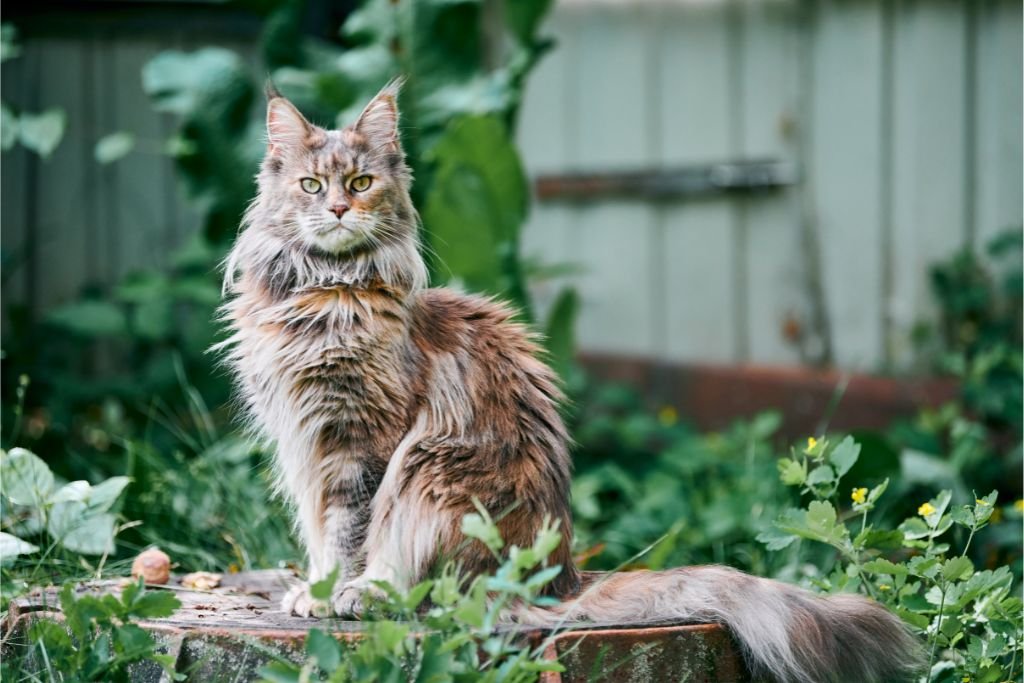
Maine Coon vs Domestic Long Hair Personality Comparison
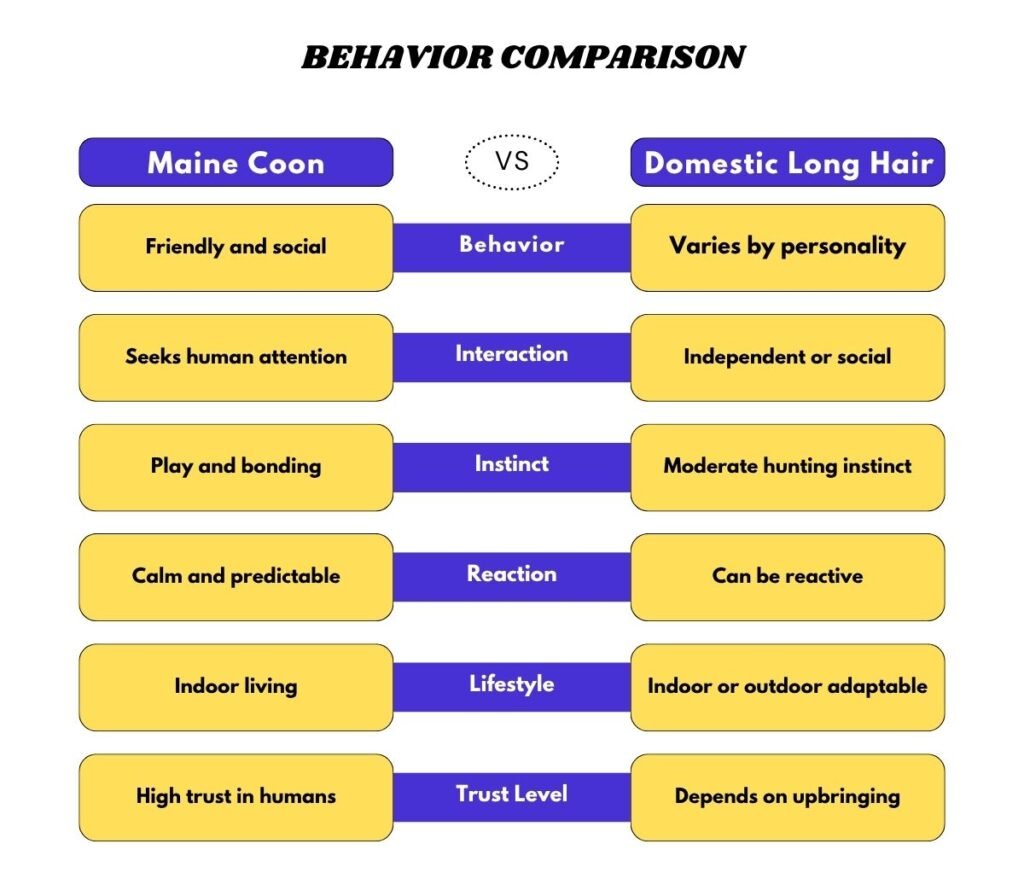
When selecting a long-term cat-companion, it is important to consider personality and temperament of the breed. Maine Coons are known for their calm and gentle frames of mind. For that reason, they would be great for families that have young children and maybe even some other pets. They are known to form very strong bonds with their owners, and they also enjoy interacting with their owners, Gentle, and Quiet MEOWS sound and follow their owners around the house. These types of personality traits are easy to predict and understand.
The Domestic Long Hair, however, is a completely different experience. On the whole, they have a broad range of different mind types. In the case of Domestic Long Hair, the inner personalities of the cats might really range and are almost considered to be a different mind type. Many Maine Coon owners say their cat behaves like a dog. It follows them from room to room. In contrast, some Domestic Longhair cats prefer independence and quiet spaces. For example, some cats are highly social and enjoy being jumped with and chased around the house, and others are very calm, unbothered, and almost indifferent. These types of personalities are closely related to the early socializing of the cat as well as the living situations that the cat has been a part of. For example, a young Sophie: the alley cat rescue used to be a very shy cat, but after getting appropriate socialization and nurturance, she turned into a very warm and loving cat. This case also displays the importance of social and environmental factors in shaping the personality of the cats as is very clear in that Domestic Long Hair breed.
Animal behaviour studies shared by RSPCA emphasize that a cat’s personality is heavily influenced by early socialization and environment. If you are comparing energy levels, Maine Coon vs Savannah Cat shows a much more active and wild personality difference.
Intelligence, Trainability and Behaviour
When assessing intelligence, Maine Coons and Domestic Long Hair present opposing attributes influenced by genetics. Maine Coons showcase an organized type of intelligence that is more compatible with domestic life. They learn patterns quickly, follow rules, and are responsive to demands. Owners are able to teach them simple commands or motivate them to play with interactive toys, establishing a deeper relationship with the pet.
Domestic Long Hair cats present intelligence that is more diverse and reflective of their complex heritage. Problem-solving with high degrees of curiosity is an attribute seen in some, whereas others are more inclined towards independence and low levels of engagement. Behaviours are often inherited from wildcat ancestors which can make them quite fascinating or unpredictable. Due to the genetic diversity in this breed, training success greatly depends on the individual cat and not necessarily the breed.
Health, Lifespan and Genetics Concern
The health of Maine Coons and Domestic Long Hair is differentiated by irresponsible breeding practices. Maine Coons are a result of intentional breeding which cause them to hold certain genetic health defects such as hypertrophic cardiomyopathy and hip dysplasia. Responsible breeders do screenings to eliminate the health defects, adding more years to the breed’s life and protecting the breed’s integrity. With proper care, their life expectancy is seen to be about 12 to 15 years.
Maine coon cats are a relatively new breed, and because of that, they are considered a breed that often has fewer genetic diseases, and therefore can be healthier and live longer than other cats. However, cats that were lost or abandoned may be exposed to more diseases because they live in untreated poor conditions, and may go to the vet less often. But with vet visits, many cats can live as long as 15 to 20 years.
| Aspect | Maine Coon | Domestic Long Hair |
|---|---|---|
| Lifespan | 12–15 years | 12–18 years |
| Health Issues | Genetic risks | Fewer inherited issues |
| Care Needs | Moderate | Variable |
Grooming, Diet and Daily Care Needs
Maine Coons have to be groomed every day because they have longer and thicker hair. Maine Coons also have to get their nails trimmed because they are a larger cat, and need a larger, well balanced diet. Luckily, Maine Coons are more quiet than Domestic Long Hairs, and therefore can be more easy to groom. A proper Maine Coon Diet is essential because their larger body requires more balanced nutrition than average cats.
Domestic Long Hairs need to be cared for more… many Domestic Long Hairs need to be groomed and fed a balanced diet according to their environment (indoors or outdoors). Indoor cats may need less food than outdoor cats (so be sure to feed them less to avoid obesity). Outdoor cats may need more food because they are less sedentary than an indoor cat.
Experts at ASPCA recommend regular brushing for long-haired cats to prevent matting and reduce shedding.
Which Breed is right for you?
This decision depends more on flexibility, which cat you choose to live with. Maine Maine Coons are more reliable choice because they can be docile, and are a more calm animal than Domestic Long Hairs.
A Domestic Longhair, on the other hand, suits those who appreciate uniqueness and variety. Each cat brings a different Personality shaped by its history and environment. Adopting a DLH also supports ethical responsibility and community appreciation by giving a home to cats that might otherwise remain strays.
Pros and Cons
| Aspect | Maine Coon (Pros) | Maine Coon (Cons) | Domestic Long Hair (Pros) | Domestic Long Hair (Cons) |
| Personality | Gentle, calm, highly affectionate, and social with family members | Can sometimes be shy or reserved with strangers | Very diverse personality; can be extremely loving and bonded with owners | Behaviour is unpredictable due to mixed background |
| Size & Appearance | Large, majestic, and lion-like appearance with strong bone structure | Needs more indoor space due to large body size | Wide variety of looks, colors, and patterns including tabby and solid coats | No fixed standard appearance, so quality varies |
| Intelligence | Highly intelligent, trainable, and can learn routines easily | Not always extremely mentally active compared to very high-energy breeds | Can show strong survival intelligence from stray backgrounds | Intelligence level is inconsistent across individuals |
| Grooming | Thick longhair coat is beautiful and manageable with routine brushing | Requires regular grooming to avoid matting and shedding | Some DLH cats have easier coats depending on mix | Grooming needs vary widely and can be unpredictable |
| Adaptability | Adapts well to indoor living and stable environments | May become lazy if not mentally stimulated | Highly adaptable to different environments including community settings | Some may struggle in strictly indoor-only homes |
| Family Compatibility | Excellent with children and families; very patient nature | May not tolerate overly chaotic environments | Many DLH cats bond strongly with owners and families | Some cats remain independent and less social |
| Health | Generally strong but may have genetic issues like HCM in some lines | Requires careful breeding to avoid inherited diseases | Genetic diversity often leads to stronger immunity | Unknown history may hide past health issues |
| Allergies | Not hypoallergenic but coat is easier to manage | Can still trigger allergies in sensitive individuals | Some individuals produce fewer allergens depending on mix | No predictable allergen level across population |
| Maintenance Cost | Moderate grooming cost compared to other longhair breeds | Larger size means higher food and care expenses | Often lower initial cost (many adopted as strays or community cats) | Health and grooming costs vary unpredictably |
| Activity Level | Moderate energy, enjoys relaxed indoor lifestyle | May not satisfy owners wanting very active pets | Can be playful, active, and energetic depending on background | Some may be too independent or low-energy for interactive homes |
Conclusion
Maine Coon vs Domestic Long Hair is a comparison of two different paths formed by history, genetics and environment. One is about consistency and controlled breeding, the other is about diversity and natural selection. Both give you companionship, but they will take different levels of understanding and care.
Finding the right cat is about matching your way of life with the needs of the animal. A Domestic Long Hair will give you more individuality and more surprises. Understanding the differences means you can have a deeper and more meaningful relationship with your cat.
FAQs
Is a DLH the same as a Maine Coon?
No, a DLH is not a breed, a Maine Coon is a breed with set characteristics.
In Maine Coon vs Domestic Long Hair, which cat is more affectionate?
Maine Coons are generally more predictable in affection, DLH are the unpredictable ones.
Do Longhair cats shed more?
Most DLH cats shed a lot, but shedding varies with coat type.
Are Maine Coons more healthy than DLH cats?
Due to their mixed DNA, DLH cats usually have less genetic disorders.
How to spot a Maine Coon?
Maine Coons are DNA tested to confirm, but they are large with ear tufts and a bushy tail.
Are Domestic Longhair cats good to have?
With good care they tend to be very affectionate.
Are Maine Coons more work with grooming?
Maine Coons need more grooming because they have thicker coats.