Table of Contents
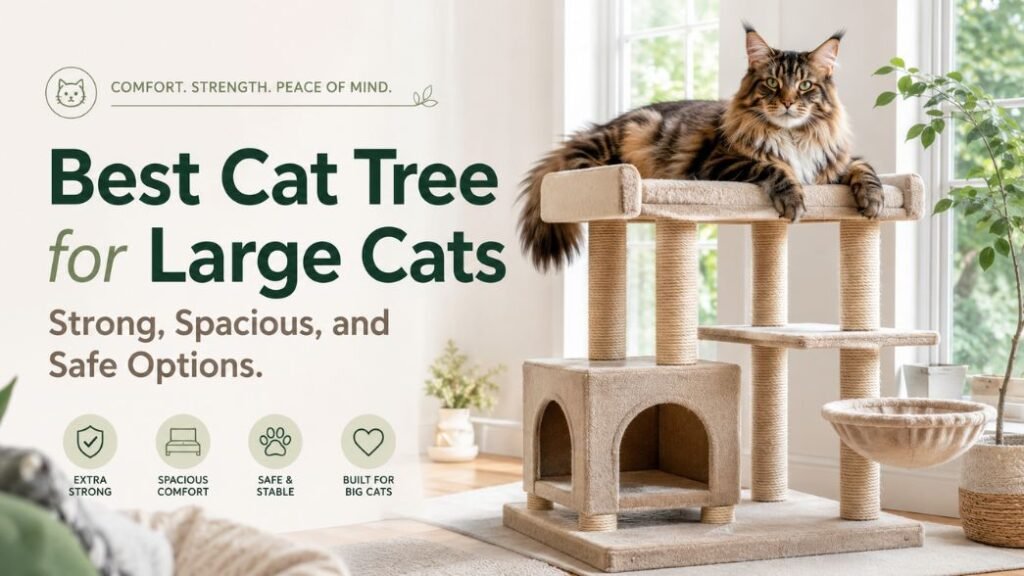
You can’t get away with buying a tiny cat tree for large cats. These cats require giant, functional, and sturdy cat furniture. The best cat tree for large cats has to be able to hold weight, endure jumps, and not wobble like a cheap camping chair.
Big cats want the same things as little cats. They want tall shelves, comfortable spots, lots of scratching space, private areas, and a good vantage point. They want the same things, but their body size changes everything. a Siberian, Norwegian Forest Cat, Bengal, or heavy domestic shorthair can put serious pressure on furniture. If the cat tree feels weak to the cat, it’ll end up not being used as originally intended.
“A good cat tree should feel like furniture your cat trusts, not a toy your cat tests.”
Introduction: Why Bigger Cats Need a Stronger Cat Tree
Larger cats need stronger cat trees because their bodies are heavier, longer, and have a larger force when jumping. A small perch may support a kitten, but it may not support a long adult cat that wants to sprawl. Think of a cat tree like a chair. A tiny stool may look nice in a photo, but it won’t feel good if your whole body does not fit on it.
Strong cat trees improve indoor cats’ behaviour by allowing them to explore a more natural build. Climbing, scratching, hiding, and napping in elevated spaces help cats feel safe and more in control of their environment. For more breed-specific setup advice, see our complete Maine Coon care guide before choosing furniture, toys, and resting spaces for a larger cat. The AAFP and ISFM feline environmental needs guidelines recommend vertical resting and viewing for indoor cats to improve their comfort and safety and provide enrichment that encourages more natural behaviours.
Why Standard Cat Trees Often Fail Large Breeds
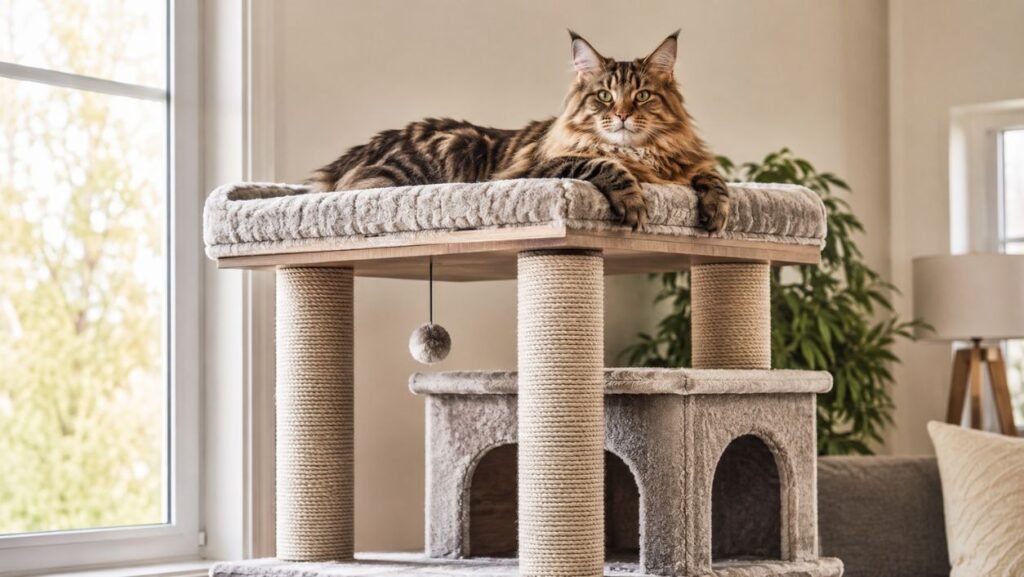
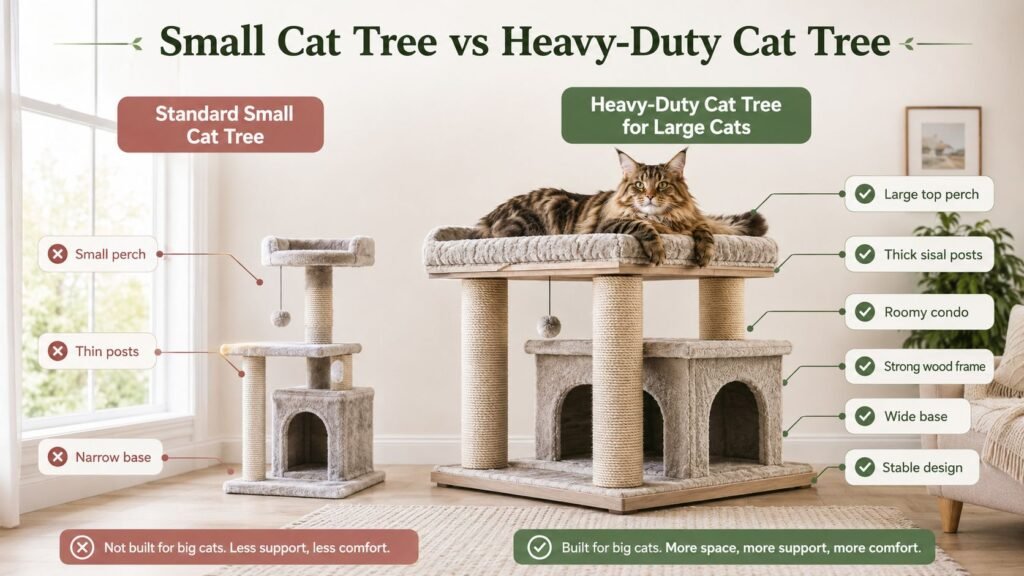
Many standard cat trees focus more on aesthetics than strength. They rely on small and light materials to create elements of the design that may only be efficient for smaller, lighter cats and fail catastrophically when larger breeds jump and land on thin beds, posts, and bases. If you are still comparing large breeds and their home needs, our compare cat breeds page can help you see how size, coat type, and activity level differ.
Good cat trees for larger cats would include wider beds and tougher scratching posts in addition to a more sturdy, heavier base to prevent the cat tree from rocking and thus losing the cat’s trust. A cat tree should earn its space in your home. If your cat ignores it, then it is just an expensive room decoration.
| Common Problem | Why It Matters for Big Cats | Better Choice |
| Small top perch | The cat cannot rest fully | Wide padded bed or flat platform |
| Narrow base | The tree may wobble or tip | Wide, heavy, reinforced base |
| Thin posts | Posts loosen faster | Thick sisal-covered posts |
| Tiny condo | Large cats avoid cramped spaces | Oversized condo with wide entry |
| Weak covering | Fabric tears or flattens | Durable plush, carpet, or woven fabric |
Key Features to Check Before Buying a Cat Tree for Large Cats
When you are in search of the large cat tree, you should not just go for the tall or fluffy-looking ones. Height is helpful, but stability matters more. A shorter tree with a strong base can be safer than a tall tower that shakes every time your cat climbs.
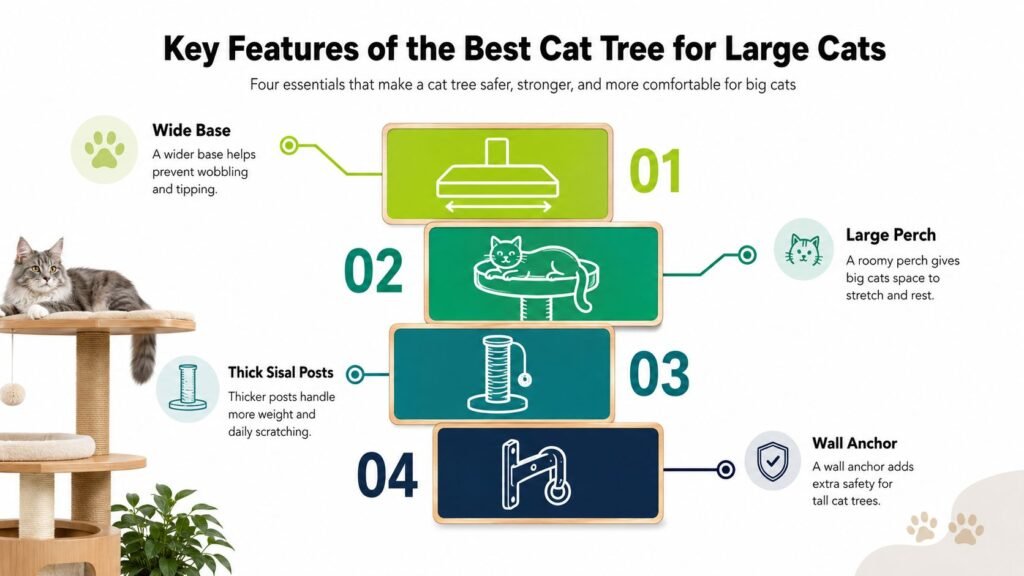
You’ll want to go through some of the product description and features before making that click to buy. Know the size of the base and total height, the size of the perches, how wide the openings are of the condos, thickness of the posts, material, and the weight limit. If you happen to come across a seller that presents information as vague, particularly by using the terminology of ‘large’, you should be careful. Your cat needs real space, not marketing fog.
| Feature | Good Sign | Warning Sign |
| Base | Wide and heavy | Narrow and light |
| Perches | Big enough for full lounging | Small round seats |
| Scratching posts | Tall and thick | Short and skinny |
| Condos | Roomy with large openings | Decorative but cramped |
| Hardware | Strong screws and brackets | Loose or unclear assembly |
| Safety | Wall strap or anchor option | No anti-tip support |
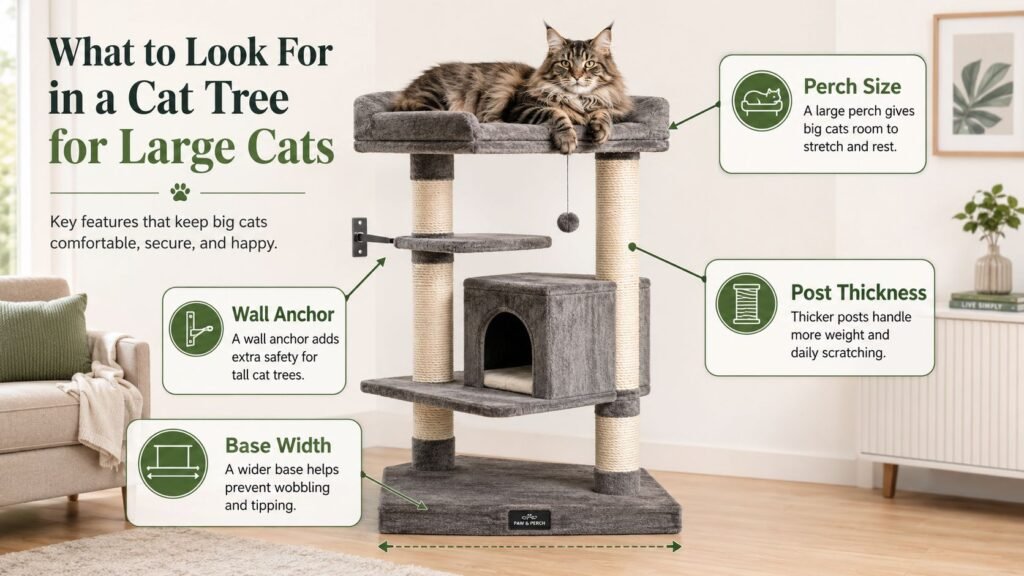
Wide Bases and Anti-Tip Stability
The foundation of a safe cat tree for big cats starts with stability. Large cats exert much greater forces when they jump as compared to small cats. Because of this, tall and narrow towers have a tendency to sway and become unstable.
Tall cat trees should have anti-tip straps and wall anchors. Anchoring trees to a wall or corner can also improve safety. Large cats need ample room to stretch and relax as compared to small cats. Perches can sometimes look spacious in the product photos but are actually small enough to be unable to hold a large cat, forcing the cat to balance.
Large Perches, Platforms, and Condos
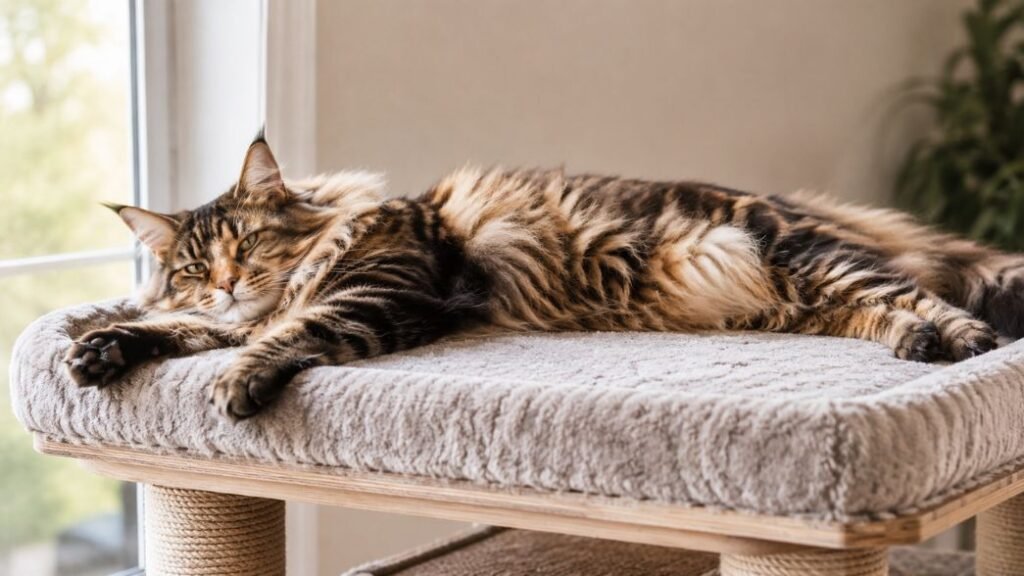
Large cats need room to sit, turn, stretch, and sleep. A perch that looks fine in a product photo may feel tiny when a 20-pound cat tries to curl up. Your cat should not have to balance like a circus performer during nap time.
Condos need special attention. Many cat condos have small doorways and tight interiors. A Ragdoll or Maine Coon may look at that little cave and walk away. Choose a cat condo for large cats with a wide entry, enough inner space, and a flat surface where your cat can rest without squeezing.
Strong Wood, Sisal, and Heavy-Duty Covering Materials
Material quality decides how long the tower lasts. Solid wood and thick plywood often feel stronger than thin boards. Heavy engineered wood can also work if the design is well-braced. Thin cardboard tubes, weak fabric, and loose staples are bad signs.
Scratching material matters too. Cats scratch to stretch muscles, care for claws, and mark their space. VCA notes that scratching areas should be large enough for a cat to stretch fully. Sisal rope and sisal fabric usually perform better than soft plush alone. You can read VCA’s cat enrichment guidance here: Enrichment for Indoor Cats.
Tall Multi-Level Designs for Climbing and Exercise
Tall multi-level designs help indoor cats move more during the day. A large cat can climb, scratch, jump, and rest without using your sofa as a gym. However, the levels must be easy to reach. A tall tree with awkward jumps can be unsafe.
The layout should feel natural. A good design starts with a strong base, then gives your cat a low step, a middle platform, a large resting level, and a top lookout. Senior cats may need ramps or lower levels. Young active cats may enjoy more height and wider jumping zones.
Best Types of Cat Trees for Large Cats
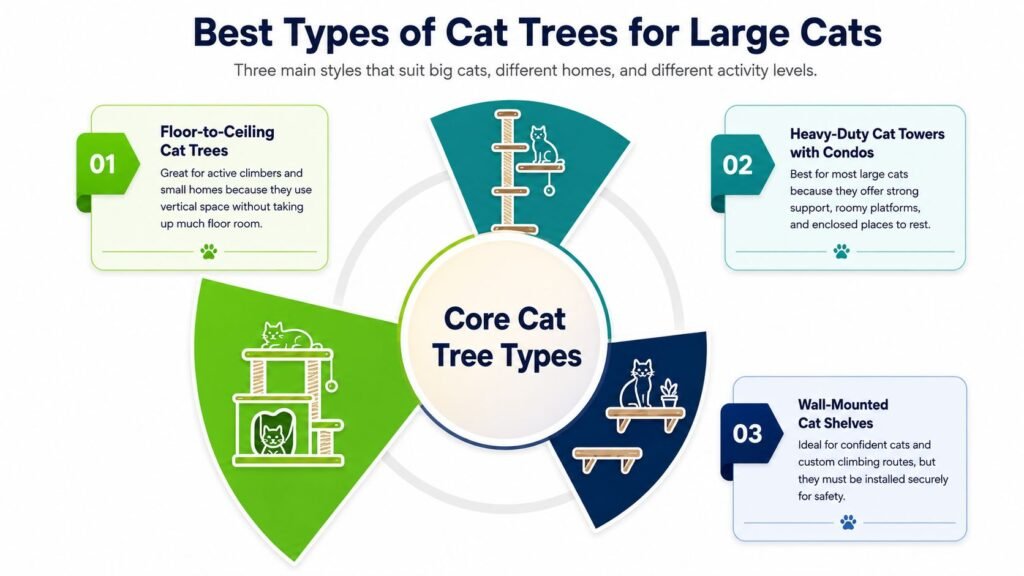
The best cat tree for large cats varies based on your home and your cat preferences. Some cats may want more height and love jumping, while others want a cozy nook in addition to areas to scratch, or only want a sunny window ledge.
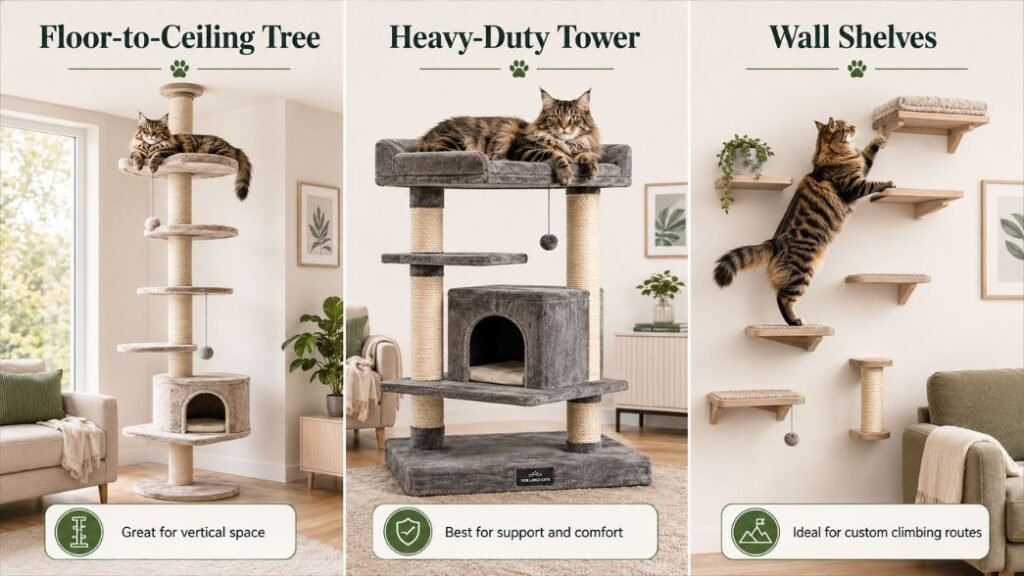
You should know of three main tree types. Floor to ceiling cat trees utilize vertical space. Heavy-duty towers support large cats comfortably, and wall-mounted shelves allow for climbing routes. Each has their ups and downs, and what you decide to choose will depend on many factors.
| Type | Best For | Main Benefit | Main Warning |
| Floor-to-ceiling tree | Active climbers | Uses vertical space well | Must fit and brace safely |
| Heavy-duty tower | Most large cats | Strong, roomy, balanced | Takes more floor space |
| Wall-mounted shelves | Confident jumpers | Custom climbing route | Needs secure installation |
Floor-to-Ceiling Cat Trees
Floor-to-ceiling cat trees work extremely well in smaller homes because they utilize height instead of floor space. They work in tight spaces, and may be best suited for places where every square foot matters, such as apartments and condos. Active cats love being able to go higher.
However, not all tension-mounted trees will be safe for heavy cats. The pole must remain robust, and the ceiling brace must remain appropriately tight, and therefore, it must be measured beforehand. For heavy or rough playful cats, look for models with robust support and weight specifications.
Heavy-Duty Cat Towers with Condos
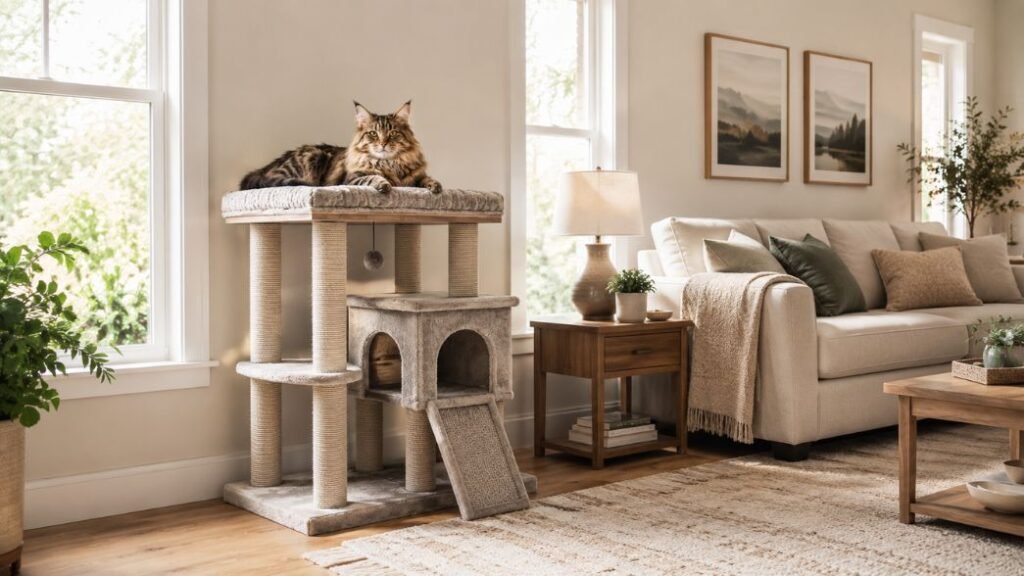
Heavy-duty cat towers with condos are the right and safest choice for large cats in your home. They tend to have wide bases, thick posts, big platforms, and enclosed rest areas. They are great for homes with Maine Coons, Ragdolls, Siberian, and large mixed-breed cats as well.
The condo should not be a tiny box added for decoration. It should be a real resting space. Check the entrance size and inner dimensions. If your cat cannot turn around inside, the condo is not useful. It is just a wooden hat with carpet on it.
Wall-Mounted Cat Shelves and Vertical Setups
Wall-mounted cat shelves can turn a blank wall into a climbing path. They can be great around homes with several cats as your cats can all select different climbing paths, climbing shelves and resting areas.
The installation is the most critical aspect. Larger cats need shelves mounted into wall studs or secured with some heavy-duty hardware. Weak drywall anchors will fail. That is not a risk worth taking. Add non-slip surfaces so your cat can land safely and move with confidence.
Choosing a Cat Tree Based on Size, Age, and Activity Level
You don’t want to buy your cat a tree based on the pretty pictures. The requirements of a young Bengal are vastly different to the requirements of a senior Ragdoll. One may want a tree with lots of height and activity. The other may want a tree with wide steps, plush beds, and a tree with easy access. It can be very costly to buy the wrong style. Body weight also connects closely with daily feeding habits, so our Maine Coon diet and nutrition guide can help you understand how size, growth, and activity affect your cat’s needs.
Remember to measure your cat before buying. You should buy a tree that their body length and shoulder width can accommodate. You should also consider your cat when they are at their heaviest. PetMD notes that adult male Maine Coons can reach up to 25 pounds. Royal Canin describes male Ragdolls as reaching up to 20 pounds. Their size should suggest the support structure rather than your guess.
| Cat Type | Better Cat Tree Choice | Why It Works |
| Young active large cat | Tall heavy-duty tower | Supports climbing and play |
| Senior large cat | Lower tree with ramps | Reduces hard jumping |
| Overweight cat | Mid-height stable tree | Encourages safe movement |
| Shy cat | Tree with large condo | Adds privacy and comfort |
| Multi-cat home | Large tree with several levels | Reduces competition |
A sturdy cat tree supports movement, but the right food supports the body doing that movement, so you may also want to read our guide to the best food for Maine Coon cats.
How we choose
We evaluated large cat trees based on base stability, perch size, material strength, scratching surface, condo dimensions, anchor options, and suitability for cats over 15 pounds.
| Feature | Recommended for Large Cats |
| Base width | At least 22–24 inches wide |
| Perch size | At least 16–20 inches wide |
| Weight support | Match or exceed cat’s body weight |
| Scratching post height | Long enough for full stretch |
| Safety | Wall anchor for tall models |
Placement Tips for Improved Safety and Useable Cat Trees
Placement is more important than is often thought. A strong cat tree could be a total flop if placed incorrectly. Cats are often drawn to places where they can view their people, have a glimpse outside, and be away from the noisy traffic within the home.
A particular favourite is the ideal window location. The ASPCA states that window perches and cat trees can help provide vertical space and give a cat something to observe. You can view their cat enrichment guide here: Environmental Enrichment for Cats. Be sure, though, that the window is indeed closed and secure.
| Placement Spot | Why Cats Like It | Safety Note |
| Near a window | Birds, light, outdoor movement | Keep screens secure |
| Against a wall | Feels stable and protected | Use anchor straps if tall |
| Living room corner | Social but not exposed | Avoid busy walkways |
| Bedroom corner | Quiet resting space | Keep away from heaters |
| Near existing scratch area | Redirects scratching | Reward use gently |
How to Introduce Your Large Cat to a New Cat Tree
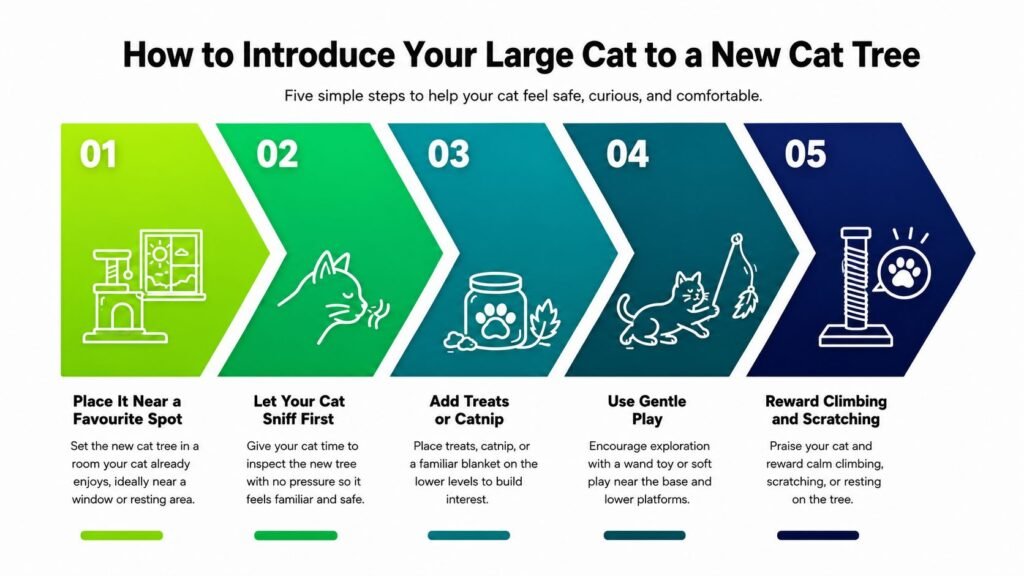
Many cats use a new tree immediately. Others think it came from another world. That is normal. Cats trust familiar smells and tree experience. Do not force the cat onto the tree. It can make cat scared.
Build the tree where cat spends time. Build the blanket on a lower platform. Use treats, catnip, silvervine, or wand toy at the base. Allow cat to discover the tree. When the cat scratches, reward, climb, or nap tree. It should be done slowly.
| Step | What To Do | Why It Helps |
| Day one | Let the cat sniff the tree | Builds trust |
| First week | Add treats on low levels | Creates interest |
| Playtime | Use a wand toy nearby | Makes it fun |
| Rest time | Add a familiar blanket | Adds home scent |
| Long term | Keep it clean and steady | Builds daily use |
Maintenance Tips to Keep the Cat Tree Safe for Longer
Even the best cat tree for large cats needs care. Big cats put daily stress on screws, platforms, posts, and fabric. A little monthly checking can prevent a loose post or risky wobble later.
Make a habit of tightening the screws. Check the sisal for loose rope. Vacuum the cat beds. If your large cat sheds heavily, our Maine Coon grooming guide can help you manage loose fur before it takes over every perch, condo, and blanket. Wash removable cushions when possible. Look for cracked boards, exposed staples, sharp edges, and weak seams. Use pet-safe cleaners without harsh scents because strong smells may make your cat avoid the tree. For long-haired cats that leave fur on every soft surface, choosing the best brush for Maine Coon cats can make cat tree cleaning much easier.
| Maintenance Task | How Often | What To Check |
| Tighten screws | Monthly | Loose posts and platforms |
| Vacuum fabric | Weekly | Fur, dust, and dander |
| Check sisal | Monthly | Loose or frayed rope |
| Wash cushions | As needed | Odor and stains |
| Inspect base | Monthly | Cracks or bending |
| Check wall anchor | Monthly | Strap tension and screws |
Common Mistakes to Avoid When Buying Cat Trees for Large Cats
A mistake that can happen when purchasing larger cat trees is buying one based on photos. Some cat trees show good sizes in a photo but have small platforms. Small cats or kittens are often used to show the tree, but can be misleading on the tree being used to hold larger cats.
Another mistake is chasing height while neglecting the base. Tall is not the best. A tall feeble tower is a disaster waiting to happen. Prioritize stability, space, and clear measurements. Style comes after safety. Your cat does not care if the tower matches your curtains.
| Mistake | Why It Fails | Smarter Move |
| Buying only by height | Tall towers can wobble | Check base and anchor options |
| Ignoring perch size | Big cats hang off edges | Compare real dimensions |
| Choosing tiny condos | Large cats avoid them | Check entry and inside space |
| Skipping material checks | Cheap parts wear fast | Choose wood, sisal, and strong fabric |
| Hiding it in a spare room | Cat may ignore it | Place it where the cat lives |
FAQs About Cat Trees for Large Cats
What is the best cat tree for large cats?
The best cat tree for large cats supports their body on all perches and doesn’t wobble when they jump. Typically, cat trees with large bases and large platforms are best. If your large cat is very large, be sure to consider the weight limit and the real measurements of the perches.
How tall should a cat tree be for a large cat?
Tall cat trees of five to seven feet are best for large, younger, and more active cats. For older large cats, select a cat tree of three to four feet. More important than tall heights is that they can safely and easily access the tree.
Are cat trees worth it for indoor cats?
Yes, cat trees are definitely worth it for indoor cats. Cat trees provide places for cats to rest, scratch, hide, and climb, which decreases their boredom and can help protect your furniture.
Do Maine Coons need special cat trees?
Yes. Maine Coons are large and long, which makes perches on cat trees for small cats uncomfortable for them. Cat trees that have large platforms, large condos, large bases, and sturdy climbing posts are the best for Maine Coons.
How do you keep a cat tree from tipping over?
Place the tree on a flat floor and keep it against a wall or corner. Tighten all screws after assembly. For tall models, use wall anchor straps when available. If the tree still wobbles after that, it may be too light or too narrow for your cat.
What material is best for a heavy-duty cat tree?
Solid wood, plywood, thick engineered wood, sisal rope, sisal fabric, and durable upholstery are good choices. Soft plush can be comfortable, but it should not be the only strong feature. The inner frame matters more than the outer fabric.
Where should I place a cat tree in my house?
Place it where your cat already likes to spend time. A window area, living room corner, or quiet bedroom spot can work well. Avoid doorways, heaters, fireplaces, open stair edges, and unstable furniture. The best spot gives your cat a view and keeps the tower steady.