Table of Contents
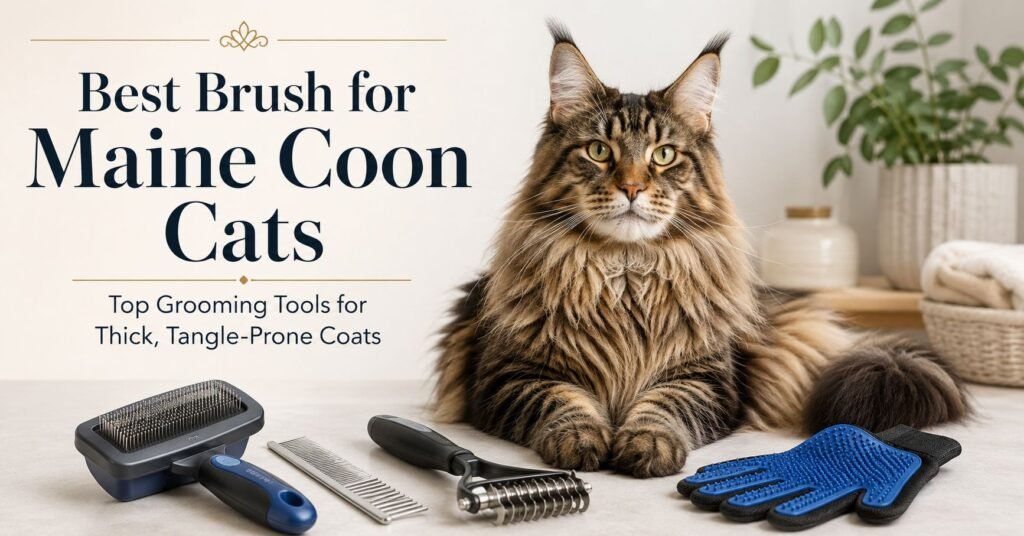
Maine Coons, the gentle giants of the feline world, look like miniature lions of the forest and are certainly one of the most beautiful breeds. However, their abundant, long, and thick fur can easily clump or mat if brushed incorrectly. Choosing the best brush for Maine Coon grooming requires more careful consideration than simply clicking the prettiest option on Amazon. The right brush is one that safeguards the skin and reaches and removes loose undercoats. This thoughtful consideration will help your furry friend feel at ease during their grooming session.
Maine Coon cats are built with semi-long, heavy, water-resistant coats. According to the International Cat Association (TICA), the Maine Coon’s coat developed to help the breed survive harsh north eastern climates and cold weather conditions. TICA mentions this feature as being beneficial compared to northeast weather. Maine Coons have thicker coats around their ruff, stomach, britches, and tails. One flat brush can miss these zones, and CFA notes that Maine Coons typically need brushing or combing two to three times a week. The Cat Fanciers’ Association (CFA) also explains that regular coat maintenance helps reduce tangles and keeps the Maine Coon’s thick fur healthy and manageable. In addition, PetMD mentions that brushing helps reduce heavy shedding and prevents matting.
What Is the Best Brush for Maine Coon Cats?
Maine Coons benefit from using a self-cleaning slicker brush, a stainless-steel cat comb, and an undercoat rake. The slicker brush is great for the outer coat, while the stainless-steel cat comb covers the deeper coat layers. The undercoat rake helps out when the Maine Coons undercoat starts to take over the outer coat.
Maine Coons are designed to have a stout undercoat while being tough on the outer sides. A tool that slides across Maine Coons outer coat can miss hidden knots in their undercoat. Fewer tools can put a Maine Coon on the path to looking neat.
| Grooming Need | Best Tool | Why It Works |
| Regular brushing | Self-Cleaning Slicker | It lifts loose hair and separates the Coat. |
| Hidden tangles | Stainless-steel Tooth Comb | It finds knots that brushes miss. |
| Heavy shedding | Undercoat Rake or Deshedding Tool | It removes loose undercoat before it clumps. |
| Brush aversion | Grooming Gloves | They feel more like petting than grooming. |
| Sensitive finishing | Bristle Brush or bristle brush | It smooths the guard coat and adds shine. |
| Early mats | Mat Splitter or matt breaker rake | It can break small mats when used gently. |
Why the Maine Coon Coat Needs Special Care
A Maine Coon Coat is extra-long with the texture and the density. There’s a layer of built in insulation. That fur gives needed warmth in the winter and protects from the elements, especially around the neck, belly, and tail. In a USA home with heating, air conditioning, carpeting, and dry indoor air, that same fur can shed in waves. Loose fur gets trapped underneath and starts to knot.
This is why grooming needs patience and the correct tools. A soft bristled brush may make the fur shiny, but may not get to the undercoat. A deshedding tool may snag too much if used daily. The goal is balance. VCA Animal Hospitals explains that poor coat condition in long-haired cats may sometimes indicate underlying health, obesity, or grooming problems. You want comfort, shedding control, hygiene and coat maintenance without causing irritation or skin issues. For a complete routine on bathing, coat care, shedding control, and brushing schedules, see our detailed Maine Coon Grooming guide.
Best Brush Types for a Maine Coon
Almost all Maine Coon owners for the first time will require a slicker brush. It has fine pin needles that clear and define the coat. A slicker should be stiff and not sharp, and the handle should be designed for precision and control and should allow for the application of light pressure. If a cat is flinching, sticking a leg out to prevent the brush coming near it, or leaving the room, the technique or tool is likely incorrect.
A cat comb matters just as much. The Comb tells the truth. When it catches, your Coat is still full. A wide Tooth Comb works well for the first pass. A finer Comb works near smaller knots. These Tools help emotional growth through the removal of uncertainty.
| Brush Type | Best Use | Good For Maine Coons? | Watch Out For |
| Slicker brush | Loose hair and light tangles | Yes | Don’t press hard. |
| Pin brushes | Gentle daily brushing | Yes | May miss deep undercoat. |
| Bristle Brush | Topcoat shine | Sometimes | Not enough alone. |
| Undercoat Rake | Thick seasonal undercoat | Yes | Use gently and not daily. |
| Deshedding Tool | Heavy shedding periods | Sometimes | Overuse can irritate Skin. |
| Grooming Gloves | Nervous cats | Yes | Weak for deep knots. |
| Mat Splitter | Small mats | With care | Bad technique can hurt. |
Slicker Brush
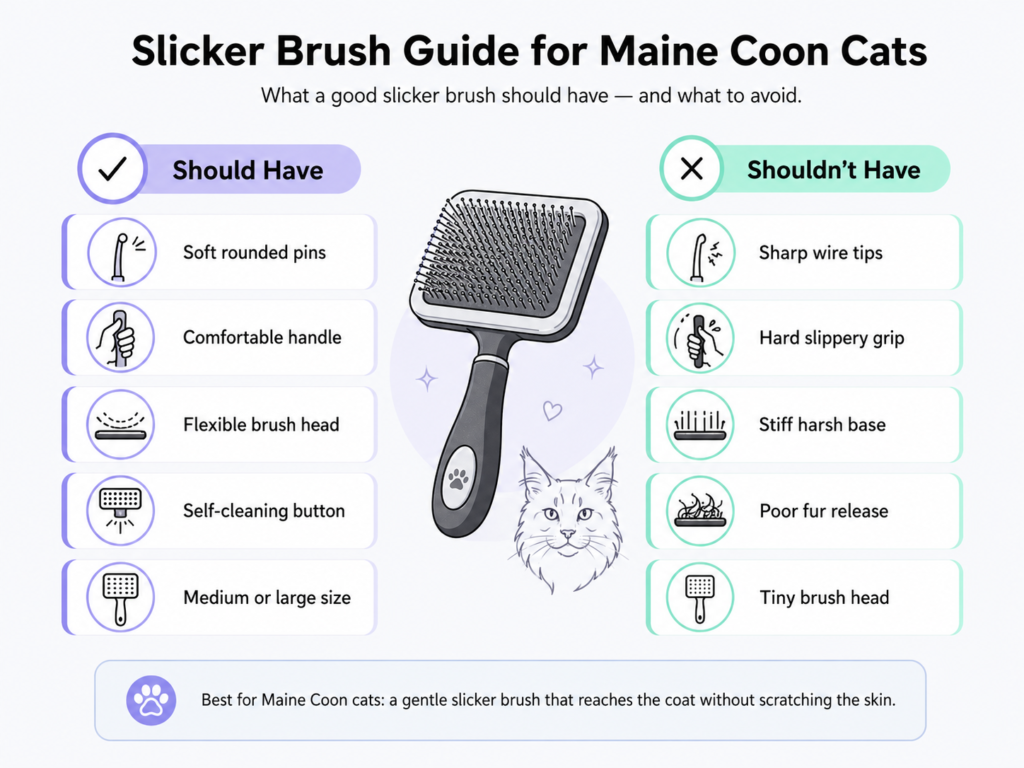
One of the more essential grooming tools for a Maine Coons is a slicker brush because it helps remove loose fur, and light tangles, and dead hair from the thick coat. Slicker brushes work especially well on the back, sides, chest, and tail, where loose undercoat often hides beneath topcoat. For a Maine Coons, a slicker brush should feel gentle, not scratchy. The goal of a slicker brush is to lift fur and separate the coat without creating an irritation on the skin.
Pin Brushes
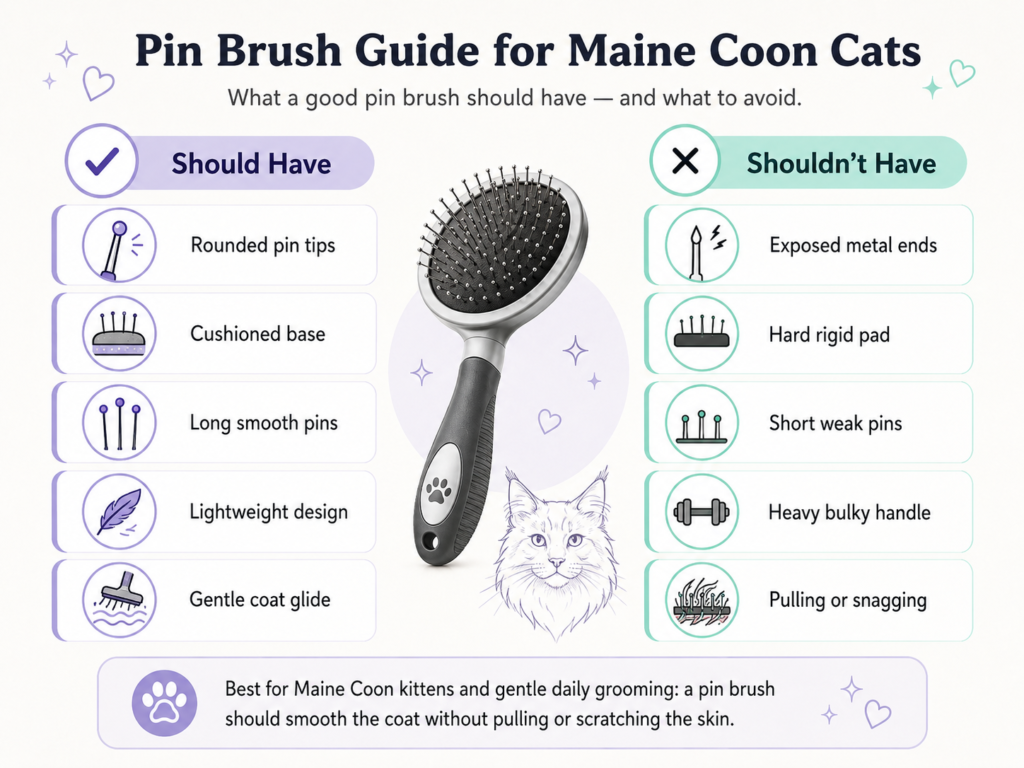
Pin brushes are perfect for daily, gentle grooming but don’t do much for deep undercoat removal. These brushes give the coat a finishing touch to remove small surface tangles and help keep the coat neat for periods between more thorough grooming. Pin brushes are also good for Maine Coon kittens because these brushes feel softer and less frightening than the other grooming brushes. Of course, they should not be the only brushes used on an adult Maine Coon because of their thick coat.
Bristle Brushes
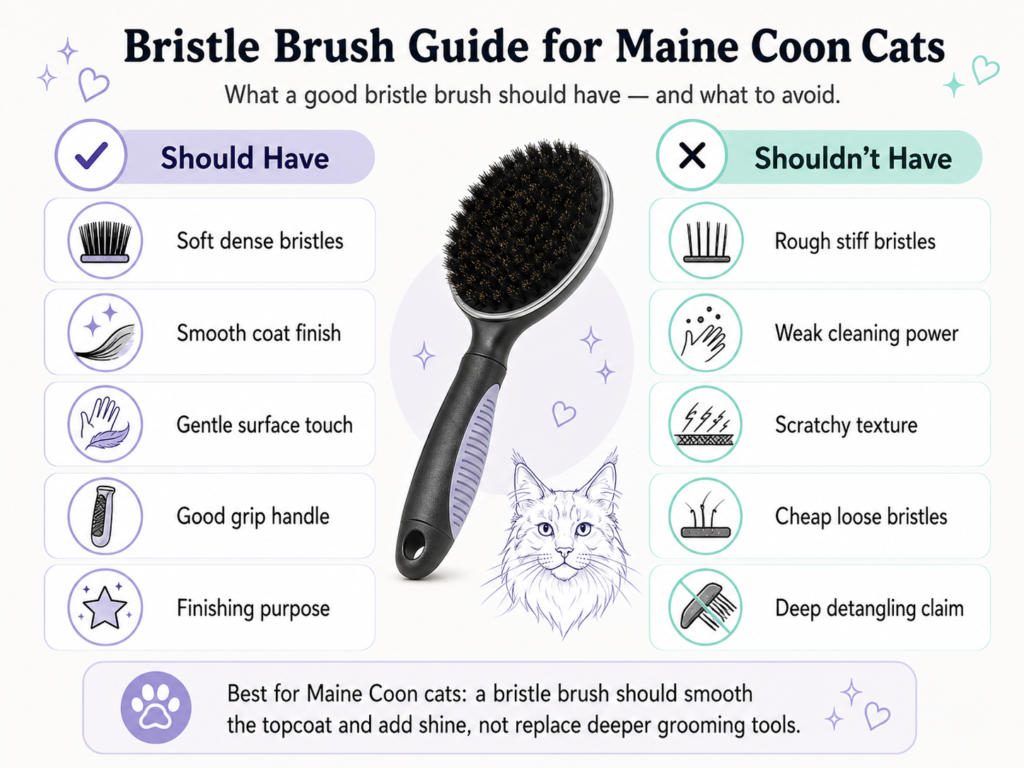
Bristle brushes come in very handy for Maine Coon grooming, as they help to smooth the outer guard hair coat and even help to spread the outer coat and natural oils to the coat, giving it a shiny look. They are very nice finishing brushes and do best to smooth the coat after a good undercoat rake, comb, or slicker brush. On their own, however, bristle brushes do a poor job, as they are quite soft and do not help to soften thick undercoats.
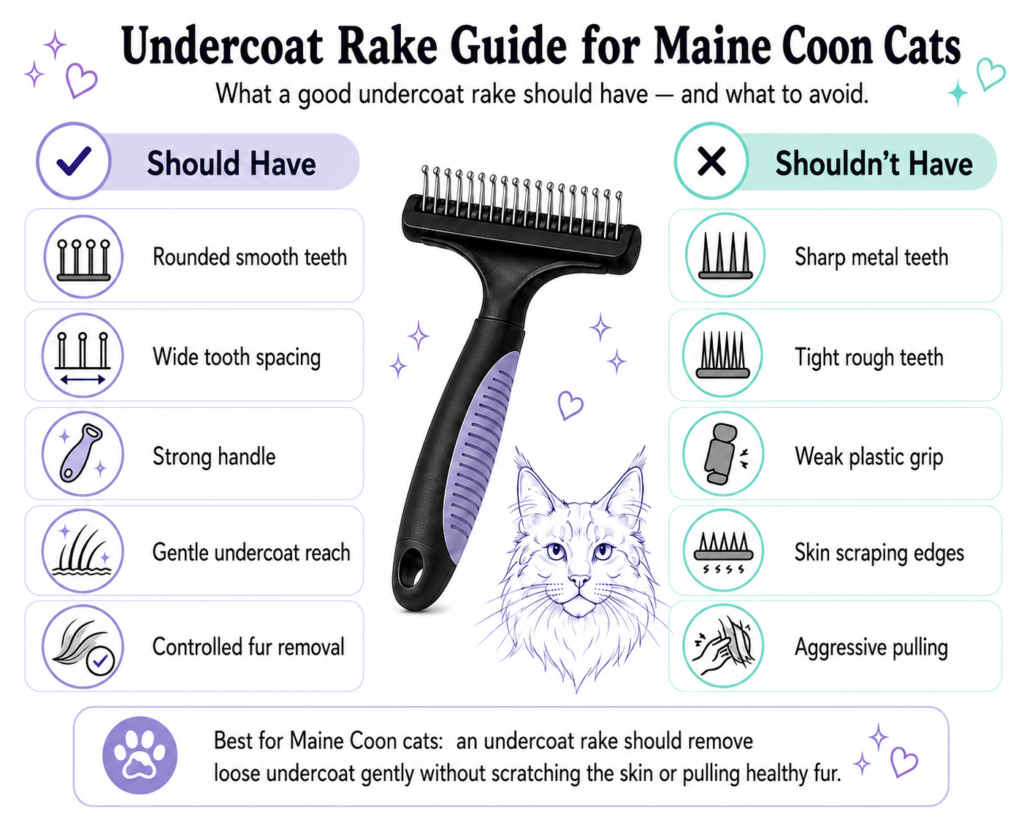
Undercoat Rakes
Undercoat rakes are very beneficial for pampering Maine Coons, as they help to remove thick undercoats and help to reach the fluffy undercoats of the Maine Coons. These do an excellent job when the Maine Coon is shedding, as they bring a bunch of fur that the Maine Coon loses and help to comfort the owner who has to buy a lint roller to remove the tufts of hair from clothing. A good undercoat rake does help to give a Maine Coon a good bathing, as they do help to remove a good amount of the Maine Coons healthy undercoat.
Deshedding Tool
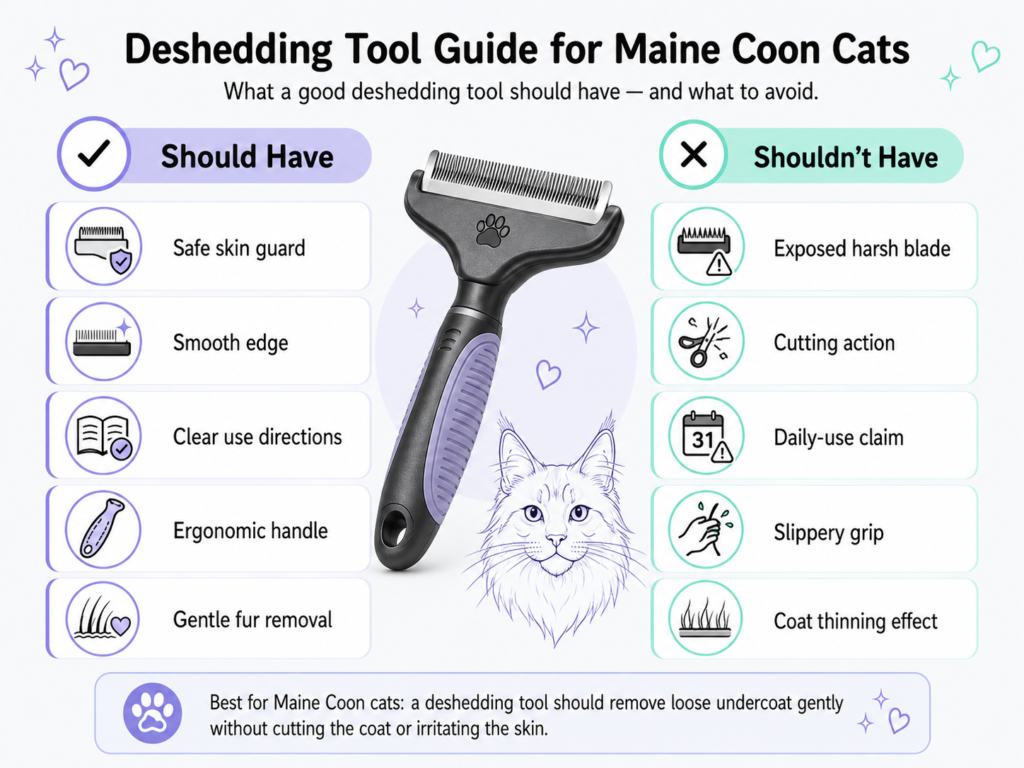
A deshedding tool is good for adult Maine Coons that shed a lot, especially during seasonal changes. This tool helps with the seasonal shedding by getting rid of the undercoat that spreads, and gets caught in carpets, clothes, and the sofas. This tool needs gentle use. Manufacturers of deshedding tools such as FURminator also recommend avoiding excessive pressure and overuse to prevent skin irritation. This tool is not meant for daily use, and should never be pressed hard into the skin while brushing.
Grooming Gloves
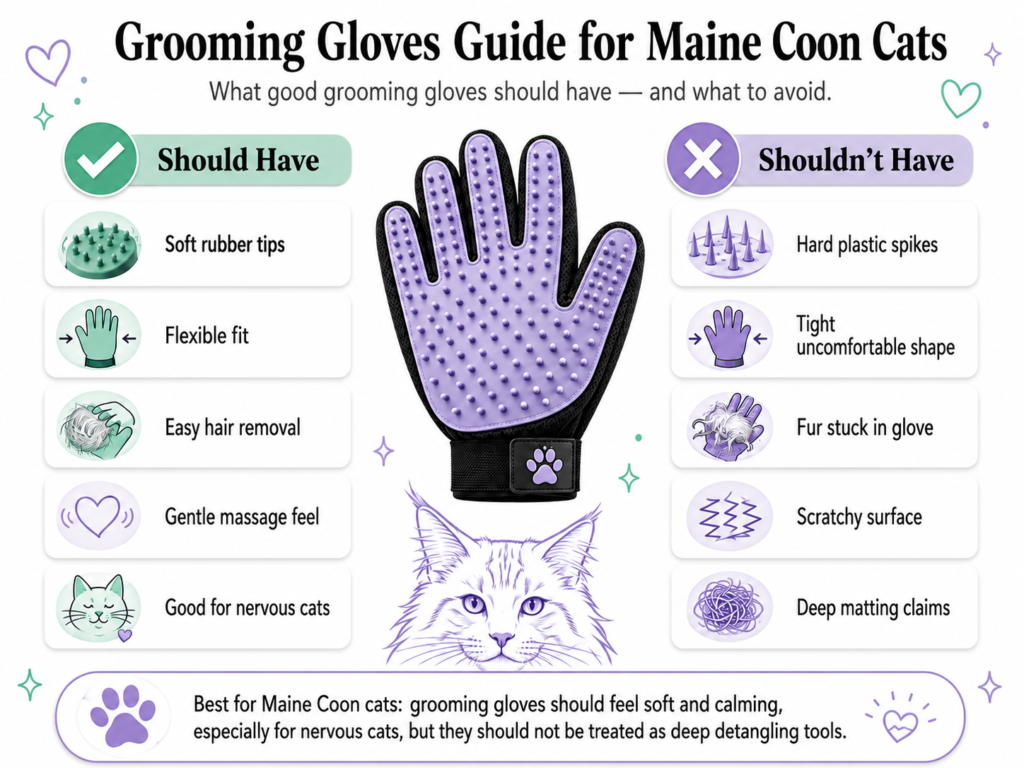
If your Maine Coons don’t like normal brushes, Grooming gloves are a good alternative. They are better since they reduce the feeling of a brushing aversion, and can make the grooming feel like more of a bonding experience. These gloves can help a lot with shedding, especially with nervous cats. Even so, these gloves can’t take the place of a comb or a slicker brush since they don’t help as much with thicker mats or with undercoat.
Mat Splitter
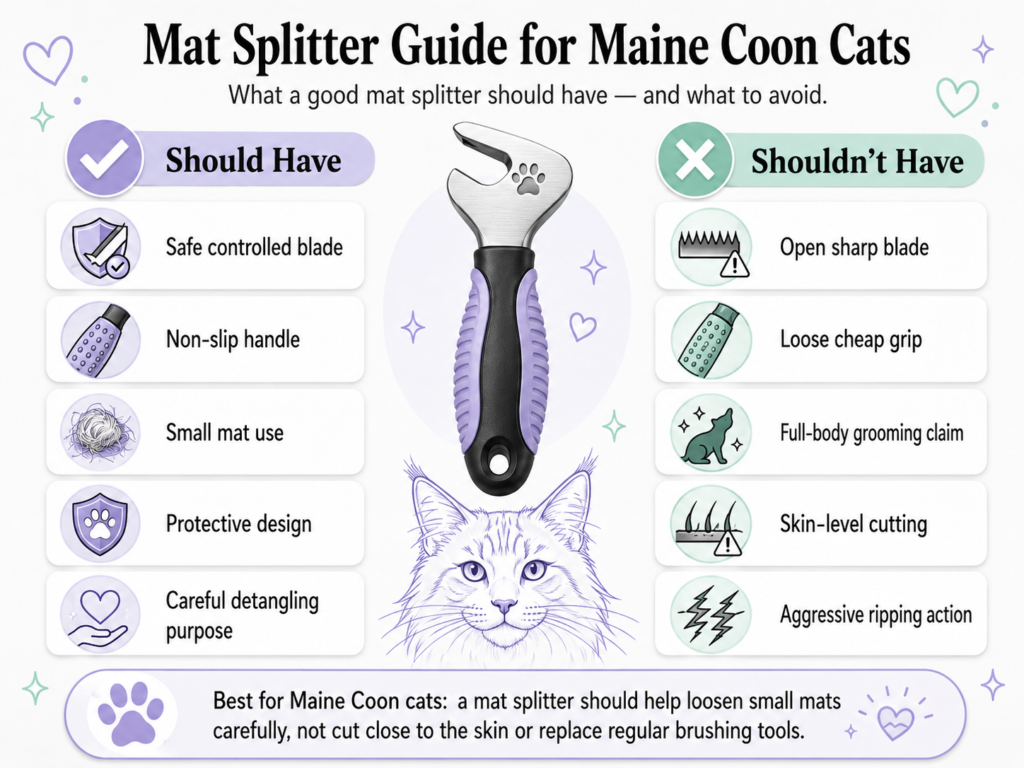
A mat splitter is a good tool for breaking apart small mats, but is not meant for regular brushing. This tool can help when a Maine Coon has a lighter mat that is more away from the skin and surface. This tool needs to be used with a lot of care since cat skin is thin and can be cut very easily. If a mat feels close to the skin and is painful, a vet or a groomer would be a better option.
Best Brush for Maine Coon Kittens
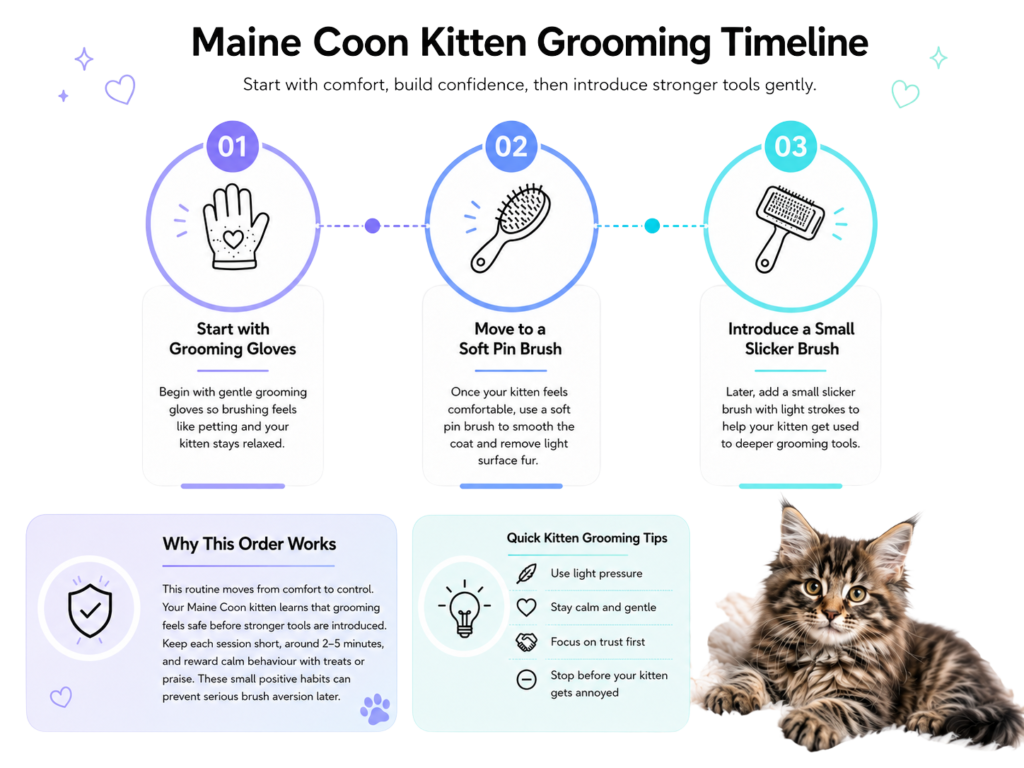
Comfort is more important for Maine Coon Kittens. They need tools that help them remove their kitten coat, like these tools below. Small brushes, soft brushes, or little slicker brushes can help Maine Coon Kittens get used to the feeling of a brush. This helps them since these cats grow and gain a lot of strength.
With kittens, control of shedding is not the main concern. The main concern is training. Always keep training sessions short and focus on the paws, tail, chest, and belly, rewarding the kitten for calm behaviour. It helps in building the trust and loyalty of the kitten. A kitten that happily accepts light training tools easily becomes a much easier adult cat to groom. Early brushing is also an important part of overall Maine Coon Care, especially during kitten development and socialization.
Soft Pin Brush for Maine Coon Kittens
A soft pin brush is one of the most secure starter tools for Maine Coon Kittens. It doesn’t make the kitten feel trapped and builds trust slowly. The deepest concern should not be shedding control at this age, but trust building. The soft pin brush smoothens the kitten’s coat, removes light surface fur, and eases the kitten into daily brushing. As Maine Coon Kittens become large cats, they also develop thick coats and early brushing builds the trust of the kitten. It helps a lot with daily brushing and care for the adult cat in the future, and especially the undercoat that becomes harder to manage and control.
| Should Have | Shouldn’t Have |
| Soft rounded pins | Sharp metal tips |
| Cushioned brush base | Hard stiff pad |
| Lightweight handle | Heavy bulky design |
| Gentle coat glide | Pulling or snagging |
| Kitten-safe size | Large adult brush head |
Gentle Grooming Gloves for Maine Coon Kittens
Gentle grooming gloves are perfect for Maine Coon kittens that feel nervous around brushes. They feel more like petting than grooming, so your kitten can relax while loose surface fur is removed. These gloves also help you touch sensitive areas like the belly, legs, chest, and tail without creating fear. This matters because Maine Coons often need regular grooming as adults, and a kitten that enjoys touch early will usually handle future brushing with less resistance.
| Should Have | Shouldn’t Have |
| Soft rubber tips | Hard plastic spikes |
| Flexible glove fit | Tight uncomfortable shape |
| Gentle massage feel | Scratchy surface |
| Easy fur removal | Hair trapped in glove |
| Good grip control | Loose slipping fit |
Small Slicker Brush for Maine Coon Kittens
A small slicker brush can help Maine Coon kittens get used to proper grooming tools before their full adult coat grows in. It removes light tangles and loose kitten fur, especially around the chest, sides, and tail. However, it must be softer and smaller than a regular adult slicker brush. A kitten’s skin is delicate, so the brush should be used with very light pressure and short strokes. If the kitten pulls away, stop early. The session should feel easy, not like a fight.
| Should Have | Shouldn’t Have |
| Soft flexible pins | Harsh wire bristles |
| Small brush head | Oversized adult head |
| Rounded pin ends | Scratchy sharp tips |
| Easy-control handle | Slippery grip |
| Light grooming action | Deep scraping pressure |
Grooming Schedule for USA Maine Coon Owners
Most Maine Coons will need more brushing compared to cats with different coats. The ASPCA recommends regular grooming for long-haired cats to help reduce shedding, hairballs, and skin irritation. Starting with brushing 2-3 times a week should be satisfactory. Silky coats require a little less grooming. Cotton coats can tangle more quickly and easily. Older cats may not groom themselves anymore. According to PetMD, brushing helps with matted and excessive shedding. According to VCA, coat-related problems may help indicate health and weight problems. A healthy coat also depends heavily on proper nutrition, so choosing the right foods from a balanced Maine Coon Diet & Nutrition plan can improve fur quality and reduce excessive shedding.
The type of furnishing you have impacts how and where fur will move. For instance, Central heating may dry out coats but humidity will cause belly fur to clump. Rugs and carpeting will work to hold some of a Maine Coons loose hair, whilst couches will grab the guard hair. For maintenance a Chom Chom-style roller can work to remove hair from a variety of furnishings.
| Cat Situation | Best Grooming Rhythm |
| Smooth adult Coat | Two or three times weekly |
| Thick undercoat | Three or four times weekly |
| Heavy seasonal shedding | Short daily sessions |
| Maine Coon Kittens | Tiny training sessions several times weekly |
| Senior cat | Gentle checks every day or every other day |
| Mat-prone cat | Daily high-risk area checks |
Grooming Tools Compared by Comfort and Results
Selecting the right grooming tools can become easy after separating the power from the comfort. Some brushes may hurt but are effective at removing fur and undercoats. The right brush will help remove undercoats without hurting horses.
Grooming should help cats learn the best behaviours. Maine Coons learn very rapidly. Cats that learn brushing and combing bring praise and treats will be more willing to be groomed. Maine Coons may play the fool, but are very intelligent.
| Tool | Fur Removal | Comfort | Best Area |
| Grooming Gloves | Low to medium | Very high | Sides, chest, nervous cats |
| Pin brush | Medium | High | Tail, ruff, daily brushing |
| Self-Cleaning Slicker | High | Medium to high | Back, sides, light tangles |
| Stainless-steel Comb | High accuracy | Medium | Armpits, belly, hidden knots |
| Undercoat Rake | High | Medium | Thick undercoat zones |
| FURminator | Very high | Medium if used gently | Seasonal shedding |
| Mat Splitter | Targeted | Low to medium | Small mats only |
Should Maine Coons Get Haircuts?
While some cat hairstyles such as the lion cut popular on social media, Maine Coons are not fashion designs. Maine Coons are not suceptible to the sun, but their coats act to protect Maine Coons’ skin from friction, insulate the Cat, and even protect the Cat from uneven temperatures. VCA even cites that most self-grooming long-haired cats manage the summer fine, and only cats that are heavily matted and struggle self-grooming might warrant a professional grooming.
A haircut might help a cat when the hair is matted severely, when hygiene is hard to maintain, or at the vet’s suggestion. A haircut is not a substitute for brushing. If a cat consistently has mats and gets haircuts frequently, there may be a problem with their grooming routine, self-care, bodyweight, skin, or the tools that are being used.
Common Mistakes with Maine Coon Brushes
Most Maine Coon brushes fail when owners only focus on the easy spots during brushing. Maine Coon owners always brush the spots where the cat shows acceptance. Mats begin in areas that are not easy to brush. These include the belly, armpits, britches, and the base of the tail.
Another mistake is relying on one tool. It is common for owners to outgrow brushes. Cats also outgrow brushes. For example, kitten brushes do not work on grown cats. Long-hair, bristle, and slicker brushes are not good for controlling undercoats. A Deshedding tool that may work for owners should also be avoided.
FAQ: People Also Ask About the Best Brush for Maine Coon Cats
What is the best brush for Maine Coon Cats overall?
The overall best brush for Maine Coon cats is a long-pin slicker brush and a stainless-steel comb. The long-pin slicker brush helps remove the top layer of Maine Coon fur while the stainless-steel comb helps remove the light and moderate tangles. The stainless-steel comb and undercoat rake should also be used during Maine Coons’ heavy shedding periods.
How often should you brush a Maine Coon?
Most Maine Coons require brushing two to three times each week. Maine Coons with cotton-like fur may require checking on a daily basis. A daily, short brushing can help prevent Maine Coons from shedding during their shedding season.
Is a FURminator good for a Maine Coon?
The FURminator is an excellent tool for Maine Coons that tend to shed an excessive amount of fur. The Maine Coon should not develop an uneven skin layer and should still be brushed with the long-pin slicker brush and comb. Owners should be cautious and observe their cat for signs of hurt and/or discomfort and stop FURminating.
Do Maine Coons need a slicker brush or a comb?
Both instruments are usually required. A slicker brush loosens and separates the coat, while a comb uncovers the depth of the coat. If the comb encounters resistance, then the coat is still tangled.
Can you use a dog brush on a Maine Coon?
Some dog brushes may be suitable provided they are gentle, smooth, and the right size. A slicker brush or rake designed for dense coats may be suitable for larger Maine Coons. Maine Coons’ skin, however, is still delicate, so steer clear of pointed pins and apply gentle pressure.
How do you stop Maine Coon fur from matting?
Prevention is the best solution for fur mats. Regularly check the areas of the body that are prone to matting, and be sure to brush before these mats form. If the mats are painful or tight, do not cut them, and instead make a vet or grooming appointment.
Are Grooming Gloves enough for a Maine Coon?
For light fur removal, Grooming Gloves do work. However, they are insufficient for the heavy undercoats that Maine Coons possess. It is recommended to use these gloves to help your cat relax, and then utilize a cat comb.
Final Thoughts
There is not just one best brush for Maine Coons. The best brushes for Maine Coons are a combination of various tools that help achieve a different and specific end. For Maine Coons, you should use a Self-Cleaning Slicker to remove loose fur, a stainless-steel comb to remove hidden tangles, and a bristle brush for a final touch. Utilize a rake for dense coats, and a pair of Grooming Gloves to help you Maine Coon relax, prior to combing.
The Maine Coon coat is long and luxurious and part of what makes this breed special. It has a gentle, wild fluff. With the Maine Coon coat, you must be gentle and brush lightly but comb deep. Always check the skin and fade when the Maine Coon gets on edge. Grooming helps the bond grow. It should feel like maintenance and a hygiene experience. If you want to compare Maine Coons with other long-haired cats based on coat type, grooming needs, personality, and shedding, explore our Compare Cat Breeds tool.